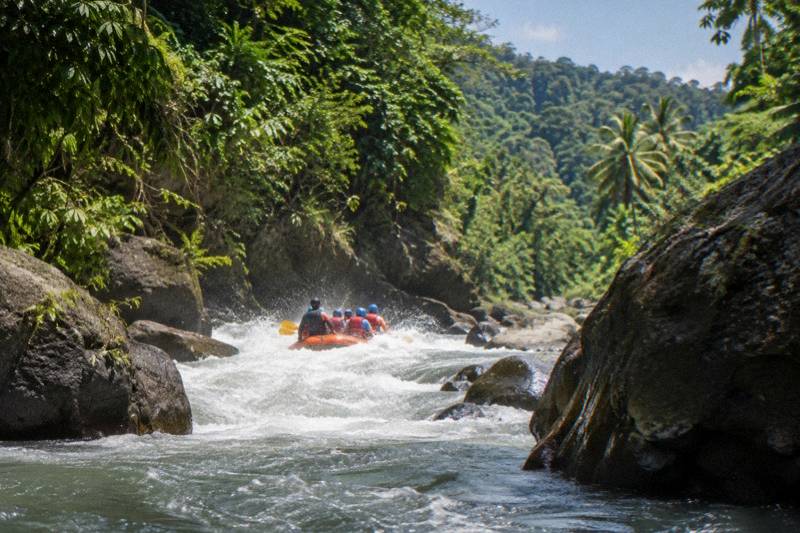
Manuel Antonio Rafting Tours: Savegre Versus Naranjo
Two rivers carry almost all the whitewater traffic from Quepos, and they are not interchangeable. Here is how the Savegre and Naranjo rafting listings actually differ.
Short answer
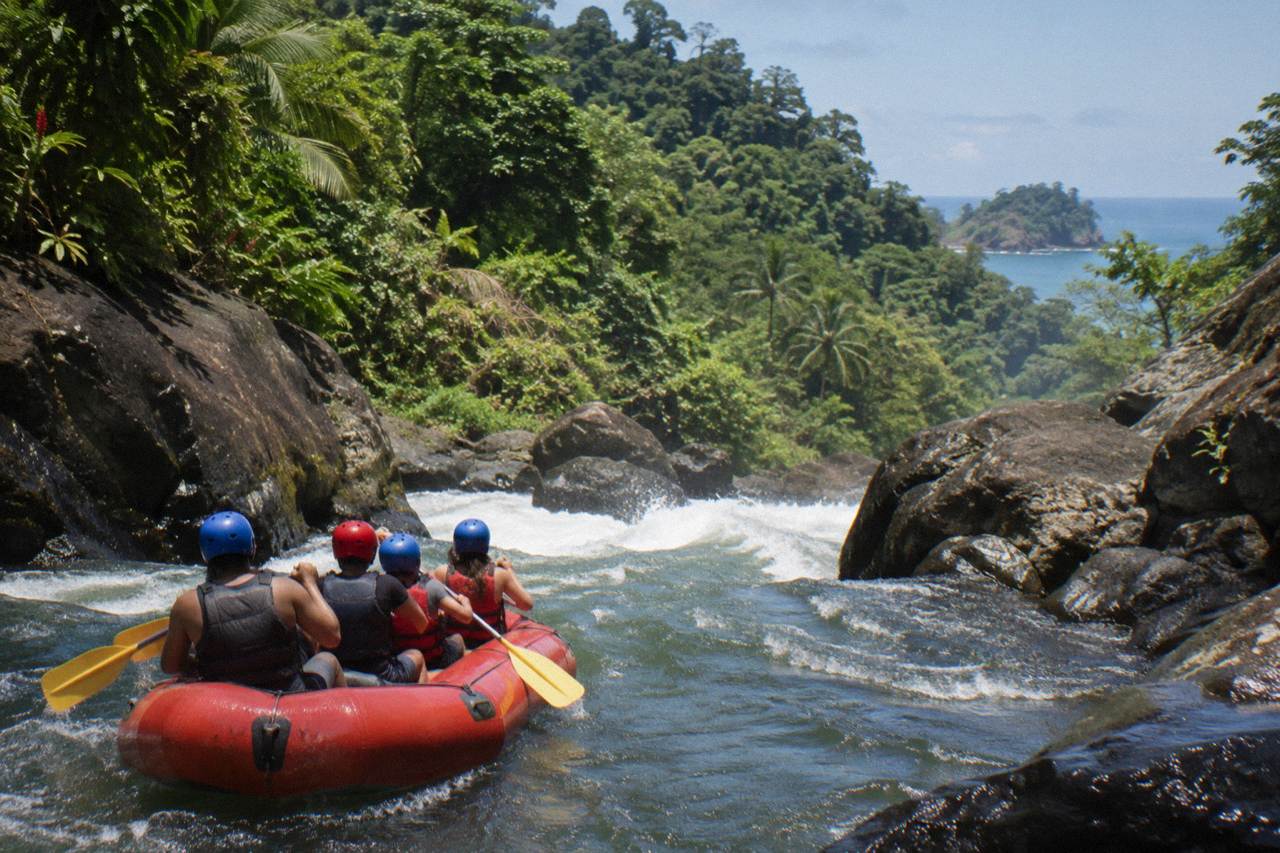
Two rafting listings run from the Quepos area: the Savegre trip, listed as Class II to III, from $129.95 per person for 6 hours with lunch, rated 5 from 831 reviews; and the Naranjo River trip, from $120 per person for 4 hours without lunch, rated 5.0 from 166 reviews. Season decides which one suits you.
Two rivers carry nearly all the whitewater traffic out of Quepos, and treating them as one product is the fastest way to book the wrong trip. The Savegre run is a six-hour day built around a Class II to III river, lunch included, hotel pickup listed, and a waterfall stop, rated 5 from 831 reviews and priced from $129.95 per person. The Naranjo River trip is a tighter four hours, from $120 per person, rated 5.0 from 166 reviews, with snacks on this site but lunch excluded. Same trailhead town, very different days. This guide compares them on class, season, length, price and physical limits, using the listings' own details plus official weather and road sources, and it sits alongside the wider coverage of Manuel Antonio Day Tours and the dedicated Savegre River Rafting page.
One framing note before the comparison. Rafting is the biggest-water item on the local adventure menu, but it is not the only way to spend a high-energy day here. The twin zip line canopy tour, rated 5.0 from 1,685 reviews, from $95 per person with lunch, is the most reviewed adrenaline listing in the catalogue, and the Damas Island mangrove boat tour with lunch, rated 4.9 from 2,910 reviews, is the calm-water alternative when rivers are too high or too low to run.
Which River Should You Raft Near Manuel Antonio: Savegre Or Naranjo?
The Savegre trip is the fuller day and the safer first rafting experience: a listing-stated Class II to III river, six hours door to door, lunch and hotel pickup listed, from $129.95 per person. The Naranjo trip is the shorter, punchier option at four hours, from $120 per person, with snacks included but lunch excluded, and pickup not stated on the listing, so transport needs checking before you book.
The Savegre listing, Whitewater Rafting Savegre Class II-III plus Waterfall, carries the class rating in its own title, which matters: it is the operator's stated description, not a third-party guess. It departs from Km 2 on the road out of Quepos, includes all taxes and fees, snacks, a driver-guide, helmet use, lunch and hotel pickup and drop-off for selected hotels. Gratuity and souvenir photos are the notable exclusions. At 831 reviews averaging a flat 5, it is also the most reviewed rafting product in the catalogue, which gives the rating more weight than a perfect score from a thin pool.
The Naranjo listing, White Water Rafting Manuel Antonio Quepos Naranjo River, runs four hours from Calle 4 in Quepos, includes snacks, a professional guide, air-conditioned transport, and vests, helmets and paddles, and excludes gratuities, photos and lunch. Its rating is 5.0 from 166 reviews, a genuinely strong pool for a shorter regional trip, but a smaller one than Savegre's. Because the listing does not state pickup, the honest position is that transport arrangements need confirming on the operator's live listing rather than assuming hotel pickup.
A useful way to split the decision is by what else you want from the day. If you are building one big excursion around rafting and want the waterfall stop, the meal and the pickup logistics handled, Savegre is built for that. If you are pairing rafting with an afternoon on the sand, or you have a morning flight of energy and a lighter budget, the four-hour Naranjo frame leaves the day open. Readers who want a fuller treatment of the longer river should also read the Savegre River Rafting guide, which covers that run in depth.
The table below puts the two listings next to each other on the fields that actually change a booking decision. Every figure comes straight from the listings.
| Field | Savegre trip | Naranjo trip |
|---|---|---|
| Listing name | Whitewater Rafting Savegre Class II-III plus Waterfall | White Water Rafting Manuel Antonio Quepos Naranjo River |
| Rating and reviews | 5 from 831 reviews | 5.0 from 166 reviews |
| Price | from $129.95 per person | from $120 per person |
| Duration | 6 hours | 4 hours |
| Stated class | II to III (in listing title) | not stated in title; guide pages describe the El Chorro section as typically III to IV |
| Pickup | listed, selected hotels | not stated; check the listing |
| Meal | lunch and snacks included | snacks included, lunch excluded |
| Free cancellation | listed | listed |
| Departure point | Km 2 road, Quepos | C. 4, Quepos |
What Class Are The Savegre And Naranjo Rapids?
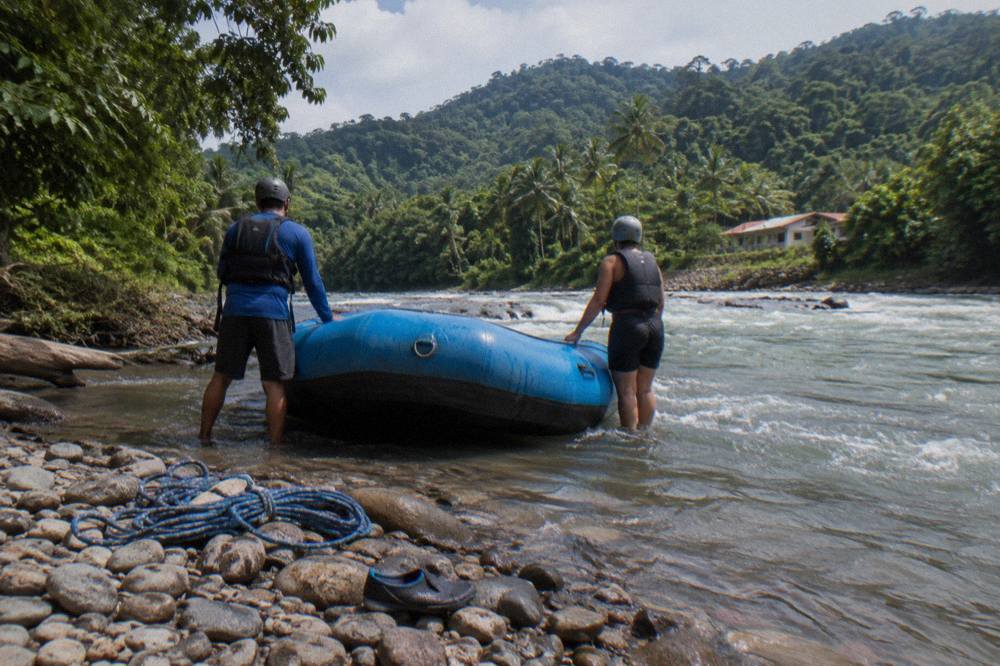
The Savegre listing states Class II to III in its own title, which is the only class rating a tour here guarantees. Regional guide pages describe the Naranjo, specifically its El Chorro section, as typically Class III to IV with a dry-season character, but no listing on this site states a Naranjo class, so treat that as described context, not a promise, and confirm with the operator before booking.
Class ratings describe difficulty and consequence, and the honest way to use them is as a floor plan rather than a forecast. A Class II rapid is straightforward moving water with clear channels; Class III adds irregular waves and maneuvers that need a guide's commands; Class IV means sustained, technical drops where precision matters. Both listings put a professional guide in the boat and a helmet on your head, and the Savegre listing includes all safety equipment in its price. The Savegre listing sets a minimum age of 6 and the Naranjo listing a minimum age of 12; both ask for moderate fitness and are not recommended in pregnancy.
Season changes the rivers more than the ratings suggest. The Savegre typically runs Class II to III near Quepos, with green-season flows from May to November energizing rapids, potentially to III to IV in heavy September and October rain, and operators modifying or canceling trips for safety. The Naranjo's El Chorro section is described as typically Class III to IV, with some sections effectively dry-season only when flows drop and expose the narrowest drops.
The practical translation: a nervous first-timer in March is looking at the Savegre listing as written, a gentle-introduction run. The same first-timer in late September, after weeks of saturated soil and afternoon storms, could meet a Savegre running harder than its title suggests, or a canceled departure. Operators make that call on the day, and the free cancellation listed on both products is the buffer that makes an early booking low-risk. If high water scrubs the plan, the catalogue's land-based options, like the waterfall ziplining and canyoning combo, rated 5 from 842 reviews, from $158.20 per person, run regardless of river state.
For readers who want the wider safety picture, the piece Is White Water Rafting Good In Costa Rica covers the national context, and families weighing difficulty should read Are Class 3 Rapids Safe For Kids, which addresses exactly this gap between a listing's rating and a child's first run.
How Long Is A Manuel Antonio Rafting Trip?
The Savegre trip runs 6 hours and the Naranjo trip 4 hours, and both are listed durations, not pure river time: they include ground transfer, gear-up, a safety briefing and food stops. Budget roughly half a day for Naranjo and a full day for Savegre, and plan the rest of your schedule around that asymmetry rather than treating the two as interchangeable.
Duration on a rafting listing is door-to-door arithmetic. The Savegre's six hours cover hotel pickup where selected, the drive inland toward the river, the put-in briefing, the run itself with a waterfall stop, lunch, and the return. The Naranjo's four hours compress that loop: the listings list snacks but excludes lunch, and the departure point is a Quepos street address rather than your hotel lobby. Neither listing states the on-water time separately; if minutes on the river are the number that matters to you, ask the operator directly before booking.
That difference should drive your day plan. Quepos and Manuel Antonio reward early starts, and the single road between them jams in high season, a point the official park guidance echoes when it tells visitors to arrive early. A four-hour Naranjo morning can still put you on Espadilla beach by early afternoon, or leave room for the 2-hour wildlife and beaches walk inside the national park, from $27 per person, if you bought your SINAC ticket online in advance. A six-hour Savegre day is effectively the whole day: you will not pair it with a second timed activity, so let it be the day.
It also changes what you eat and carry. The Savegre listing includes lunch, so the logistics are handled; the Naranjo listing excludes it, which means planning a proper meal in Quepos afterward, not a snack-bar improvisation, if you are rafting in the middle of the day in tropical heat. The packing guide, What To Bring On A Manuel Antonio Tour, covers the dry-bag, sunscreen and footwear questions in detail, and most of it applies doubled on a river.
Fitting rafting into a longer stay is its own question. If you are deciding between three nights and five, read How Many Days In Manuel Antonio Is Enough; the short version is that one rafting day plus one park day plus one water day, a catamaran or the mangroves, fills a first visit without rushing.
When Is The Best Season For Rafting Near Quepos?
The dry season, roughly December to April, is the most predictable window for both rivers, with lower flows and the Savegre closest to its listed Class II to III character. The green season, May to November, brings higher water and bigger rapids but also cancellation risk, and the national forecaster expected the 2026 dry season on the Central Pacific to start between mid and late November.
The rainfall record for Quepos makes the pattern concrete. The climate table for the town shows about 45.9 mm in January against about 544.3 mm in September, the wettest month, and about 533.5 mm in October, with roughly 219.4 rain days spread across the year. Those are averages, always "about", but the shape is unambiguous: a dry shoulder from December through March, a steep climb from April, and a saturated peak from September into early November. Sea temperature barely moves, sitting about 27.7 to 29.4 degrees Celsius all year, so it is the rivers, not the ocean, that carry the seasonal signal for rafting.
The forecast side is current and official. The national weather institute's subseasonal outlook issued in late October 2026 pointed to predominantly dry conditions establishing over the Central Pacific from late October into November, and its seasonal perspective put the estimated start of the dry season for the region between 13 and 30 November 2026. A chain of official weather advisories through mid-October 2026 described saturated soils across the Central Pacific after repeated afternoon storms and intertropical convergence activity, estimating 25 to 50 mm events with local maxima near 80 mm. In plain terms: the tail of the 2026 green season was wet, and the transition to runnable, predictable flows was expected within weeks.
| Month | Rain in Quepos (about) | What it means for rafting |
|---|---|---|
| January | 45.9 mm | Low flows, Savegre near its listed class, most reliable window |
| February | 25.8 mm | Driest month on the table, prime conditions |
| March | 40.0 mm | Still dry season, busy on all tours, book early |
| April | 156.9 mm | Transition begins, first bigger water possible |
| May to August | 389.0 to 468.7 mm | Green season, higher flows, more powerful rapids |
| September | 544.3 mm | Wettest month, highest chance of modified or canceled runs |
| October | 533.5 mm | Saturated soils per official advisories, flexible plans advised |
| November to December | 349.0 then 159.7 mm | Rains ease, dry season returns, fewer crowds early |
Crowds track the dry season too. The official park guidance notes September and October draw fewer visitors to the region, and the same logic applies to the rivers: a green-season trip can mean a fuller river experience with a smaller group, traded against weather risk. Both rafting listings carry free cancellation, which is the mechanism that makes a green-season booking rational: reserve early, watch the forecast, and rebook or switch to a land option like the zipline and canyoning combo if the operator stands the day down. For the month-by-month picture across all activities, see Manuel Antonio Weather By Month.
What Are The Age And Fitness Limits For Rafting Here?
The Savegre listing sets a minimum age of 6 and the Naranjo listing a minimum age of 12; both ask for moderate fitness and are not recommended in pregnancy. Both trips involve paddling on command and sitting stable in a moving raft, so honest advice is to read each listing's own terms and ask the operator directly about children, seniors, pregnancy, or shoulder and back conditions before you pay.
What can be said firmly comes from the listings. The Savegre trip lists hotel pickup and drop-off for selected hotels only, so mobility logistics are partly handled; the Naranjo listing does not state pickup at all. Both include professional guides and safety equipment. Operators here do apply limits; they simply publish them per product, and those limits can differ between the two rivers precisely because the rivers differ.
The comparative question families actually ask is whether a Class III river is a child's river. The Savegre's listed Class II to III is the same band many family-friendly runs worldwide occupy, but the listing's class describes the water, not your child. The article Are Class 3 Rapids Safe For Kids works through the judgment call, and What Happens If You Fall Off While White Water Rafting covers the swim scenario that worries most first-timers. The short, honest summary of both: listen at the briefing, wear the vest as fitted, and follow commands, and the systems on commercial runs are built around exactly that fallibility.
If the answers come back limiting, the region has graded alternatives that keep the day adventurous. The twin zip line canopy tour, rated 5.0 from 1,685 reviews, from $95 per person with lunch, has a published age and weight framework on its own listing, and the Nauyaca Waterfall tour, rated 5 from 456 reviews, from $155 per person for 7 hours with lunch and entrance fees included, is a swimming and viewing day rather than a paddling one. Limits on those are likewise per listing.
What Should You Bring And What Is Not Allowed On A Rafting Trip?
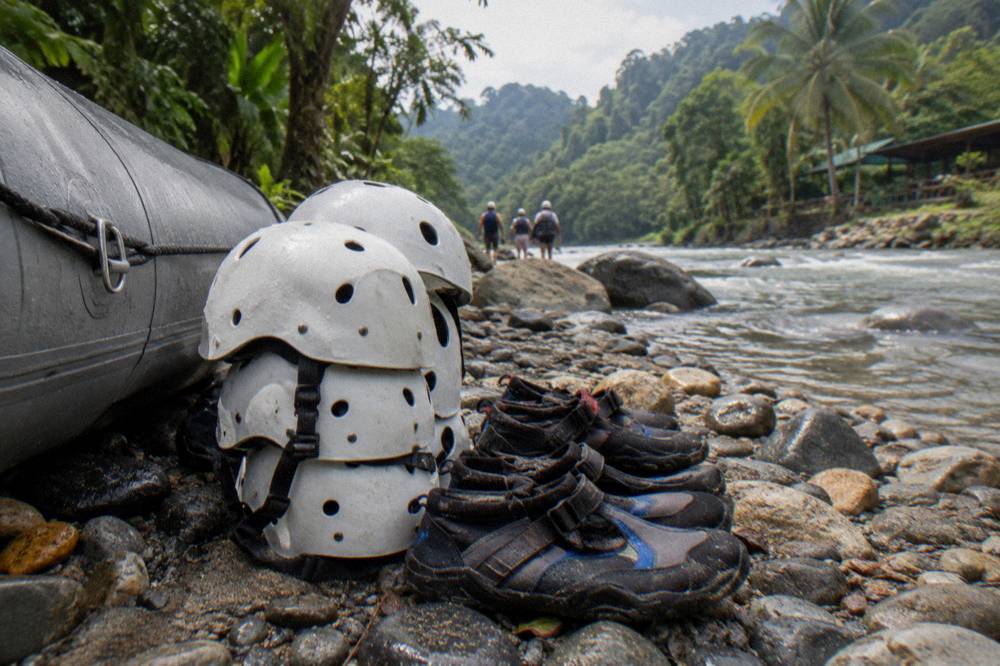
Bring quick-drying clothes, secure sandals or water shoes, a change of clothes, sunscreen applied before the briefing, and cash or a card for gratuities and souvenir photos, which both listings exclude. Leave behind valuables, drones and glass; if your day also enters the national park, food, beverages, pets, alcohol, umbrellas, tents and hammocks are prohibited by official park rules, and soap and shampoo are barred in the showers.
The exclusions columns on the two rafting listings are short and identical in spirit: gratuities, photos to purchase, and on Naranjo, lunch. Photos deserve a flag, because on a river you cannot carry a phone, and both operators sell images taken from the bank; budget for it mentally or accept that the day will live in memory. Water, snacks and equipment are included on both, and the Savegre adds a full lunch, so the food gap only bites on the Naranjo side.
Footwear is the under-planned item. The national park's own guidance recommends proper footwear and calls sandals not recommended on its trails, and river banks are worse: wet, uneven and slick at put-ins. Secure sandals with heel straps or water shoes are the standard call for rafting, flip-flops are not. A dry change of clothes for the ride home matters more than people expect, since you will be soaked through even on a swim-free run.
| Item | Savegre trip | Naranjo trip | Notes |
|---|---|---|---|
| Snacks | included | included | listed on both |
| Lunch | included | excluded | plan a Quepos meal after Naranjo |
| Helmet, vest, paddle | included | included | safety gear on both listings |
| Hotel pickup | listed, selected hotels | Not stated | confirm on the listing |
| Gratuities | excluded | excluded | cash is practical |
| Souvenir photos | excluded, purchasable | excluded, purchasable | no phones on the river |
| Free cancellation | listed | listed | the buffer for weather calls |
How Much Do Manuel Antonio Rafting Tours Cost?
The two rafting listings price from $120 per person for the Naranjo trip and from $129.95 per person for the Savegre trip, a gap of under ten dollars for two extra hours, lunch and listed hotel pickup on the Savegre side. Across the wider adventure lineup, rafting sits mid-range: zipline trips start at $90, ATV trips at $85, and the top-priced adventure listing, the zipline and canyoning combo, runs from $158.20 per person.
Those are listing prices, printed exactly as the listings carry them, per person, with "from" intact, because options such as private groups or photo packages can shift the final figure. The value question is what that small price gap buys on Savegre, and the answer is concrete: roughly two more hours, a waterfall stop, a listed lunch, and listed hotel pickup for selected hotels. On a pure cost-per-hour basis the Savegre is the better arithmetic; on a cost-per-adrenaline basis, the tighter Naranjo frame concentrates the day. Neither logic is wrong, which is why the choice is about schedule rather than money.
Placement in the wider catalogue helps calibration. The full price landscape, including the cheapest product in the entire catalogue, a park tour from $23 per person, is laid out in Manuel Antonio Tour Prices. Rafting costs more than any park or mangrove day because a river trip carries guides, gear, ground transport and insurance per head, and the two rafting listings are priced accordingly. If the rafting budget pushes your total past comfort, the honest framing is that the catalogue's cheapest adventures, ATV at from $85 and the titi canopy zipline at from $90 per person, deliver high-energy days at a lower price point than either river.
| Adventure listing | Rating and reviews | Price | Duration | Meal |
|---|---|---|---|---|
| Savegre rafting with waterfall | 5 from 831 | from $129.95 | 6 hours | lunch included |
| Naranjo River rafting | 5.0 from 166 | from $120 | 4 hours | snacks only |
| Zipline and canyoning combo | 5 from 842 | from $158.20 | 6 hours | lunch included |
| Longest twin zip line | 5.0 from 1,685 | from $95 | 4.5 hours | lunch included |
| Titi canopy zipline and rappel | 4.9 from 710 | from $90 | 2.5 hours | meals per itinerary |
| ATV rainforest and waterfalls, 4 hour | 4.8 from 167 | from $124.30 | 4 hours | lunch included |
| Nauyaca Waterfall full day | 5 from 456 | from $155 | 7 hours | lunch included |

Cancellation terms close the money question. Both rafting listings carry free cancellation as listed, so the standard play is early booking in high season, when dry-season demand fills both rivers, with the flexibility to move the day if a green-season storm system arrives. Payment at booking versus pay-later options vary by listing, and the operator's live listing is the place to confirm current terms.
Can You Combine Rafting With Other Tours On The Same Trip?
Yes, but plan one big outing per day: the six-hour Savegre trip is a full day, while the four-hour Naranjo morning leaves room for a beach afternoon or a short park walk. On a typical three-night stay, pairing one rafting day with one guided park morning and one water day, a catamaran or the mangrove boat, covers the region's three signatures without stacking timed tours on top of each other.
The pairing logic follows duration. After a Naranjo morning, the natural complements are the shorter listings: the 2-hour park tour with ticket included, from $23 per person, rated 4.8 from 590 reviews, if the SINAC ticket was bought in advance, or the 4-hour park nature guided tour, from $49 per person, the most reviewed product in the whole catalogue at 4,590 reviews, for a slower wildlife morning on another day. After a Savegre day, plan nothing but dinner.
Water-based pairings round out a stay. The sailing trip with lunch and open drinks, rated 4.7 from 653 reviews, from $95 per person, is the classic recovery afternoon after a rafting day, and the Damas Island mangrove boat with lunch, rated 4.9 from 2,910 reviews, from $75 per person, is the wildlife-water alternative if the rivers were the reason you came and you want one more day near the water. The dedicated Damas Island Mangrove Tour guide covers that run in detail, and the wider menu is in Things To Do In Manuel Antonio.
For readers building the full itinerary, including whether to base in Quepos near the rafting departures or in Manuel Antonio near the beach, see Is It Better To Stay In Quepos Or Manuel Antonio and Where To Stay In Manuel Antonio. The short version relevant here: both rafting listings depart from Quepos addresses, so a Quepos base trims transfer time on rafting morning.
Getting to the region at all is covered in San Jose To Manuel Antonio, which lays out the bus, shuttle and domestic flight options, and the official road authority announced roughly $35 million in ongoing works on Route 34 in late September 2026, including bridge work at Parrita and Savegre, described as strategic projects with no specific closure dates published, so build modest buffer into any same-day arrival plan.
The through-line of this comparison, and of everything published by Manuel Antonio Costa Rica Tours, is that the two rivers are genuinely different products: Savegre the longer, gentler-listed, more reviewed full day; Naranjo the shorter morning at the lower price. Pick by season and by schedule, book early with free cancellation as your safety net, and confirm limits and pickup on the live listing before you pay.
Common Questions About Manuel Antonio Rafting
Which river is better for beginners, Savegre or Naranjo?
The Savegre listing states Class II to III in its title, which is the beginner-friendly band, and it is the longer day with lunch and listed hotel pickup. The Naranjo trip is described by regional guide pages as typically harder water on its El Chorro section, and its listing states no class, so confirm with the operator before booking it as a first run.
How much does rafting cost from Manuel Antonio?
The Naranjo River trip is from $120 per person for 4 hours and the Savegre trip is from $129.95 per person for 6 hours, both per the listings with free cancellation listed. Gratuities and souvenir photos are excluded on both, and lunch is included only on the Savegre side.
What is the best month for rafting near Quepos?
The dry season, roughly December to April, is the most predictable window, with Quepos rainfall down to about 25.8 mm in February against about 544.3 mm in September. The national forecaster expected the Central Pacific dry season to begin between 13 and 30 November 2026.
Is there an age or weight limit for these rafting tours?
The Savegre listing sets a minimum age of 6 and its largest life jacket fits a 52-inch chest; the Naranjo listing sets a minimum age of 12. Both ask for moderate fitness, so the honest instruction is to check the listing and ask the operator directly about children, seniors or any back, shoulder or pregnancy concern before booking.
Do the rafting tours include hotel pickup?
The Savegre listing includes hotel pickup and drop-off for selected hotels only. The Naranjo listing does not state pickup, so confirm transport arrangements on the operator's live listing rather than assuming it.
What happens if the river is too high or too low to run?
Operators modify or cancel trips for safety when conditions demand it, as the regional guide pages describe for heavy green-season flows. Both rafting listings carry free cancellation, and land-based alternatives such as the zipline and canyoning combo run regardless of river state.