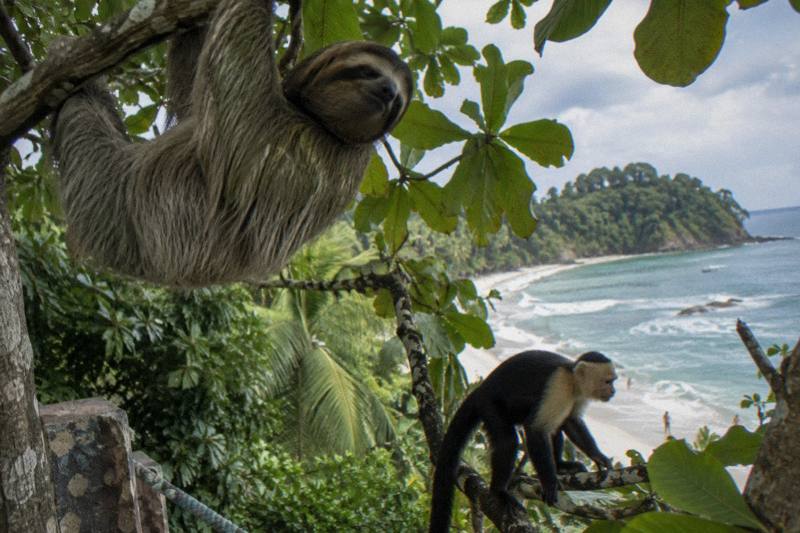
Manuel Antonio National Park Trails: Which Walks A Tour Covers
Manuel Antonio National Park packs its trails, viewpoints and three beaches into a compact strip of Pacific coastline, and the walk you choose shapes what you get from the day.
Short answer
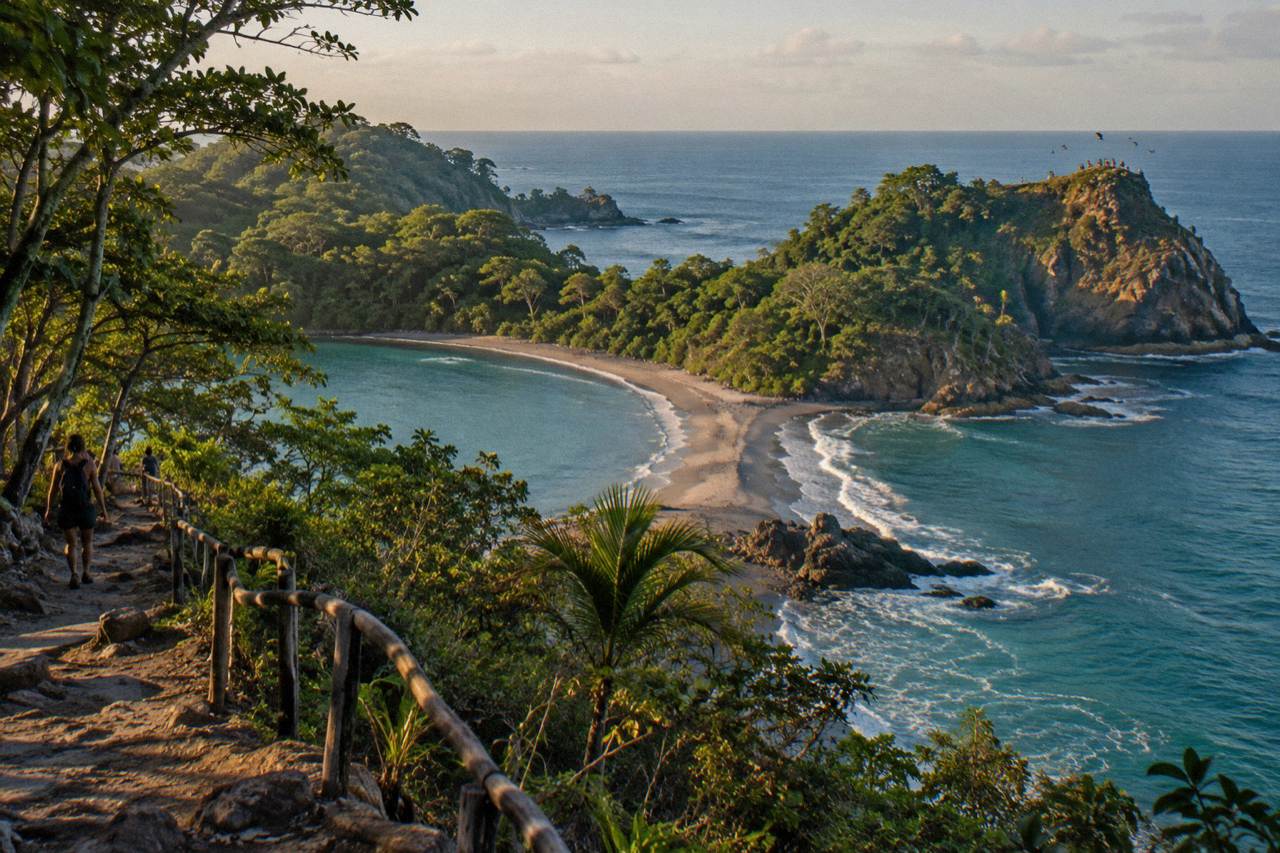
The park's trail network centers on the Perezoso trail, the beach connectors, the Gemelas and Puerto Escondido paths and the viewpoints around Punta Catedral, which the official page lists as temporarily closed. The park is open Wednesday to Monday, 7:00 am to 3:00 pm, closed Tuesdays, and foreign adult tickets cost $18.08 including IVA, bought only online.
The trail network inside Manuel Antonio National Park is small by national park standards and dense by any standard. The whole protected area sits on a hilly coastal strip about 7 km east of Quepos, and every path in it eventually leads to water: a beach, a viewpoint over the Pacific, or the mangrove and lagoon systems behind the sand. What trips up most visitors is not distance but timing and logistics. The park closes at 3:00 pm, shuts entirely on Tuesdays, sells tickets only through the official online portal, and forbids food and drink beyond the designated eating area. The trails themselves are the easy part, once you know which ones exist and what a guided tour actually covers.
This guide walks through the trails as the official park authority describes them, beach by beach and viewpoint by viewpoint, without inventing distances. It also maps the walkable network onto the guided tour listings sold from Quepos and Manuel Antonio, including the most reviewed listing on this site, the Manuel Antonio Park Nature Guided Tour, rated 4.8 from 4,590 reviews, from $49 per person, whose 4-hour format is built around exactly these paths.
What Trails And Sights Are Inside Manuel Antonio National Park?
The official park inventory lists the Perezoso vehicle trail, the beach connector paths to Playa Manuel Antonio and Playa Espadilla Sur, the Gemelas and Puerto Escondido trail, the Punta Catedral viewpoints, Punta Serrucho, La Trampa, a seasonal waterfall, roughly 18 hectares of mangrove and a 14 hectare lagoon. Punta Catedral is a former island joined to the mainland by a tombolo, a sand spit, with three viewpoints along its flank. Recorded species include about 352 birds and 109 mammals.
That list comes from the park's own English-language page, maintained by SINAC, the national conservation area system, and it is the only inventory worth planning around. Third-party sites add trail lengths and ratings that the official page does not publish, so this guide deliberately leaves numbers out and describes each walk by what you actually encounter.
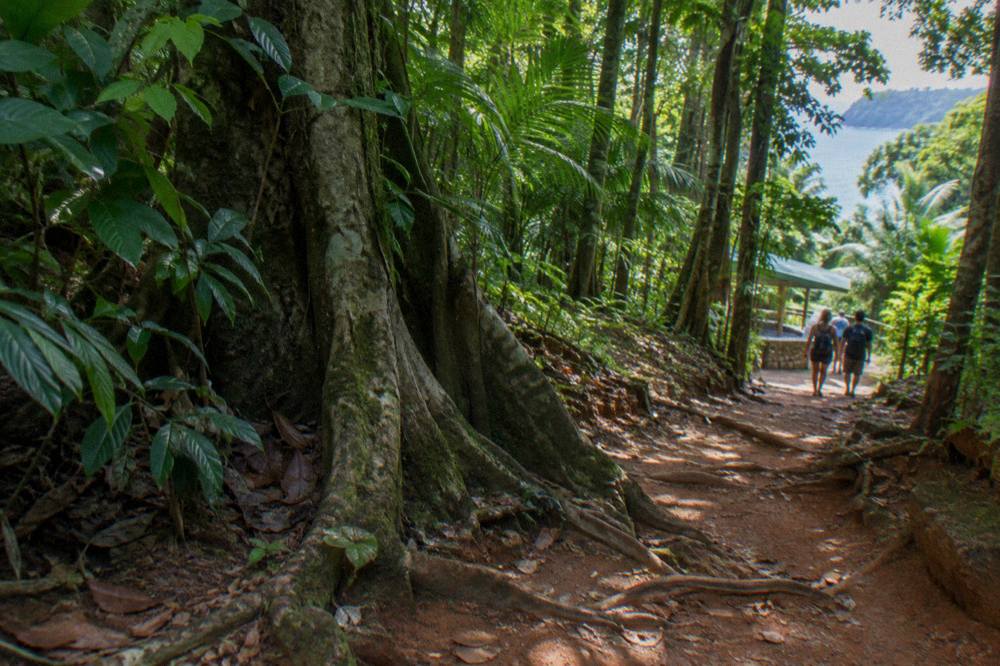
The layout is simple once you picture it. You enter from the main gate off the Quepos to Manuel Antonio road, walk in along the Perezoso trail, which is a wide former vehicle track that climbs gently through secondary forest, and from there the network branches. One branch runs down to Playa Manuel Antonio, the park's signature beach, sheltered at the ends where snorkeling is possible. Another reaches Playa Espadilla Sur, the wider, less crowded stretch that opens up at low tide and can carry strong waves in some seasons. A third heads to Playa Gemelas, a beach split in two by a rock formation, and onward to the Puerto Escondido viewpoint at the far end.
Behind the beaches sits the quieter stuff most day visitors miss: the mangrove stand of red, pinuela and gentleman species, the lagoon, the seasonal waterfall, and La Trampa, a low-tide fish and turtle trap left from indigenous use of the coast. Guides love these features because they carry stories, and stories are what a trained naturalist sells.
For a fuller picture of the animals along these paths, see the companion page on Manuel Antonio National Park wildlife, which covers the titi monkey, the park's emblem species, and the manzanillo tree on the beach whose parts are toxic, a genuine reason to listen to your guide rather than touching anything.
| Area of the park | What the official page says | Practical character |
|---|---|---|
| Perezoso trail | Vehicle trail into the park, drinking-water fountain along it | Wide, gently climbing access route, main artery |
| Playa Manuel Antonio | Snorkeling at the sides, marine life and some coral | Sheltered swim beach, busiest spot in the park |
| Playa Espadilla Sur | Wide at low tide, some strong waves in some seasons, less crowded | Quieter beach walk, check conditions |
| Playa Gemelas | Split in two by a rock formation | Short beach stop, photogenic rock formation |
| Punta Catedral | Former island joined by a tombolo, three viewpoints | Trail temporarily closed per the official page |
| Mangrove and lagoon | Roughly 18 ha of mangrove, a 14 ha lagoon | Wildlife habitat, best with a spotting scope |
| La Trampa | Low-tide indigenous turtle and fish trap | Historic feature, visible at low tide |
Is The Punta Catedral Trail Open In Manuel Antonio?
No. The English-language page maintained by SINAC states plainly that the Punta Catedral trail is temporarily closed. This page is the authoritative source, and no reopening date has been announced, so any itinerary that promises the loop around the former island, including its three viewpoints, is selling you something the park itself is not currently offering. The other viewpoints, including Punta Serrucho and Puerto Escondido, remain listed as park sights.
This matters more than you might think, because Punta Catedral is the headland that defines the park's silhouette. It was an island once, and the tombolo, the sand bar that welded it to the mainland, is the reason a beach sits on either side of it. Guidebooks and older blog posts still describe the loop as the park's main hike, and plenty of itineraries circulating online have not caught up with the closure.
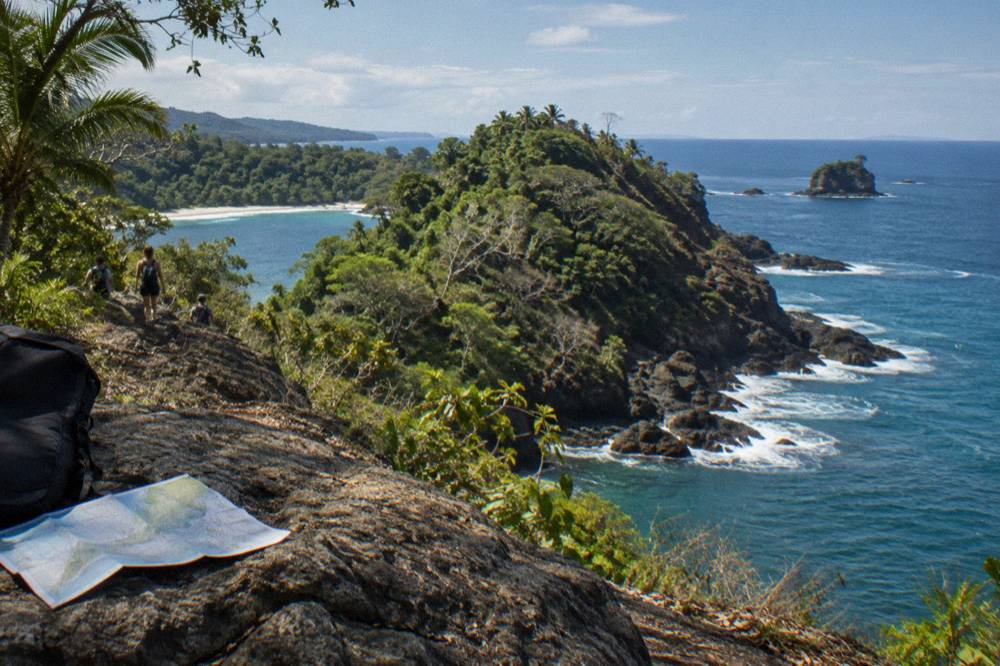
The practical adjustment is straightforward. If you wanted the elevated sea views, the Puerto Escondido viewpoint at the end of the Gemelas path and the Punta Serrucho viewpoints are the listed alternatives, and the beach trails themselves deliver plenty of coastline. If a tour listing mentions viewpoints, that is fine, but check the wording: the honest listings describe wildlife and trails in general terms rather than naming the closed loop.
There is a second closure to plan around, and it is a weekly one. The park is closed every Tuesday, open Wednesday to Monday from 7:00 am to 3:00 pm. The full schedule, including the guide office's tour hours, is broken down on the park hours and closures page. Nothing is more deflating than a Tuesday arrival at a locked gate.
The nature-specialist tour runs 4 hours with a spotting scope included, from $49 per person. The wildlife-and-beaches walk is a 2-hour format from $27 per person departing the park entrance, with beach time after the tour built into its includes line. The naturalist tour runs 2 to 3 hours from $25 per person, with professional pictures taken by your guide listed among the inclusions. Same forest, three different depths.
Which Beaches Can You Walk To Inside The Park?
Three beaches sit inside the boundary: Playa Manuel Antonio, Playa Espadilla Sur and Playa Gemelas. Playa Manuel Antonio offers snorkeling at its sides with marine life and some coral; Espadilla Sur is the wide, less crowded one that opens further at low tide; Gemelas is split in two by a rock formation. All are reached on foot from the internal trail network, and none allows food, drink, umbrellas, balls or tents.
Playa Manuel Antonio is the one on the postcards, a crescent backed by rainforest where the forest canopy feels close enough to touch. The snorkeling at its sides is the park's most accessible underwater option, and several boat and kayak listings in the area, like the ocean kayak trip to Biesanz Beach just outside the park, from $65 per person, extend that same shoreline experience beyond the gate. Conditions vary, of course, and no listing can promise visibility on any given day.
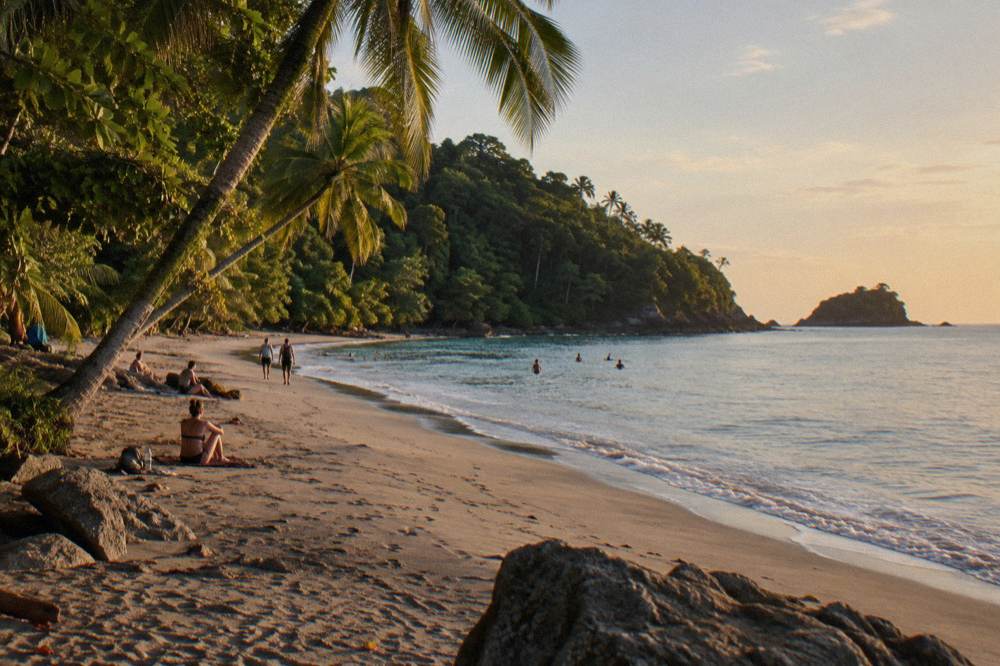
Espadilla Sur rewards the walkers who keep going. It is less crowded than Playa Manuel Antonio according to the official description, wide at low tide, and it carries strong waves in some seasons, so swim with your eyes open. Gemelas, further along, is the smallest and most photogenic of the three, split by its rock formation into two pockets of sand.
The beach rules deserve a sentence of respect. No food or beverages of any kind may be taken in beyond the designated eating area, which serves food from 7:30 am to 3:30 pm. No pets, fires, alcohol, smoking, fishing, umbrellas, balls, tents or hammocks, and no soap or shampoo in the showers. The manzanillo tree on the beach is toxic, which is why guides point it out. Footwear matters too: sandals are explicitly not recommended, and the trails turn slick in the wet season. The packing question gets a full treatment on the what to bring page.
| Beach | Official description | Best for | Watch out for |
|---|---|---|---|
| Playa Manuel Antonio | Snorkeling at the sides, marine life, some coral | Swimming, first beach stop, easiest access | Busiest spot in the park |
| Playa Espadilla Sur | Wide at low tide, less crowded, some strong waves in some seasons | A quieter beach walk | Wave conditions, seasonal |
| Playa Gemelas | Split in two by a rock formation | Photography, a longer walk |
For readers weighing the beaches against other water time, the wider coastline options are covered in the Manuel Antonio beaches guide, including the public sands outside the park that cost nothing to visit.
How Hard Are The Manuel Antonio Park Trails To Walk?
Honest answer: easy to moderate, with heat and humidity doing the real work. The paths are short, the main artery is a wide former vehicle track, and the connectors are well-trodden dirt trails with some short climbs between the entrance and the beaches. No official distances are published on the park's page. Most visitors of ordinary fitness walk the network comfortably inside a half day.
The Perezoso trail is the gentlest introduction, broad and graded, climbing gradually through forest where the drinking-water fountain is located. From there, the descents to the beaches involve short, steeper sections with steps and roots, muddy in the green season from May to November and dusty in the dry season from December to April. Footwear with grip beats flip-flops on every one of them, and the park itself recommends proper footwear over sandals.
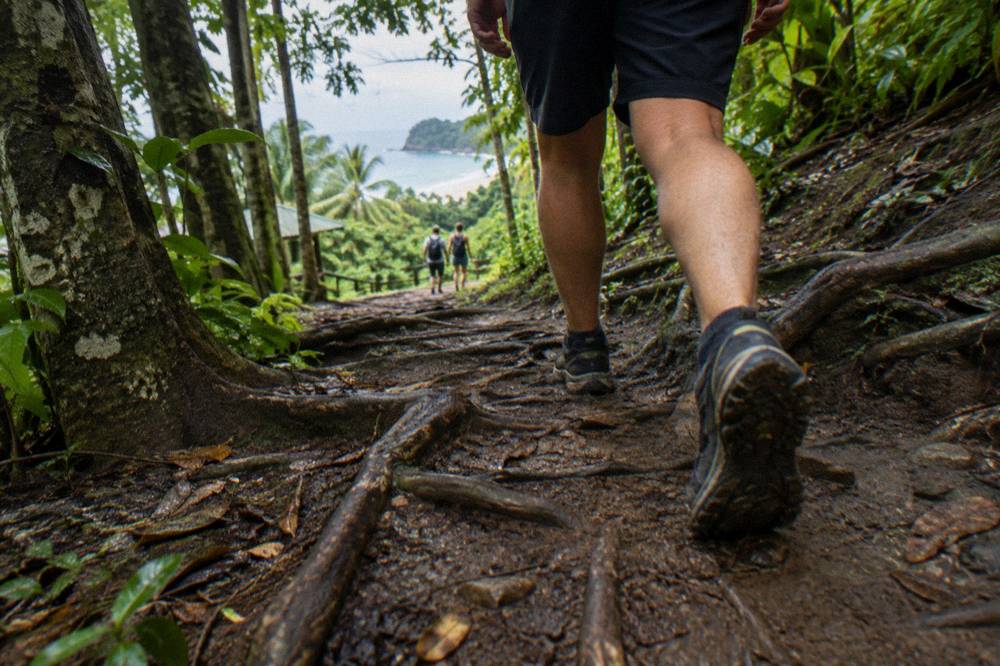
Two factors change the difficulty more than terrain. One is the 3:00 pm closing time: a midday start leaves you walking in the hottest hours with the least margin. The other is wildlife watching itself. Standing still while a guide sets up a spotting scope on a sloth or a troop of monkeys takes time, and a 2-hour tour can stretch in practice because the group keeps stopping. That is a feature, not a flaw, but it means the "how long does it take" question has no single answer; there is a fuller discussion in how long does it take to walk through Manuel Antonio National Park. If you're weighing a guided tour against exploring on your own, the walking times and arrival window breakdown shows how each choice shapes your day.
September and October bring fewer visitors because of the rain, and the official page itself suggests arriving early in that period. Early arrival is good advice in every month: the gates open at 7:00 am, wildlife is more active in the first hours, and the beach sand has not yet stored a full day of equatorial sun.
The tours that suit walkers who want an easier pace are the shorter formats. The ticket-included 2-hour tour, rated 4.8 from 590 reviews and from $23 per person, keeps the walk tight, while the 2.5-hour option with scope and photos, from $27 per person, adds a little more forest time. For anyone who wants the deep version, the 4-hour nature-specialist format exists precisely because there is more to see than a quick lap allows.
Should You Walk The Trails With A Guide Or On Your Own?
Walking alone is allowed and the trails are easy to follow, but the value of a guide is not navigation, it is detection. A certified naturalist with a spotting scope finds sloths, roosting owls, bats and tiny frogs that untrained eyes walk past in seconds, and the site's guided listings include the scope and often photos taken for you. The park's guide office runs tours from 7:00 am to 2:00 pm, which tells you most visitors go guided.
The argument for self-guiding is real: tickets are cheaper without a tour, the paths are obvious, and the beaches need no interpretation to enjoy. The argument against is bluntly statistical in a different sense. This park records about 352 bird species and 109 mammal species, and the overwhelming majority of them are camouflage specialists. A sloth in a ceiba tree looks like a termite nest. A roosting potoo looks like a broken stump. Guides find these animals because finding them is their profession, and the difference in what a group sees versus a solo walker is the difference the tour price buys.

The deeper version of the comparison, including the certification requirement for guides inside the park, is laid out in do I need a guide for Manuel Antonio National Park. The short version for trail planning: if your day is about beaches and a forest stroll, go alone and enjoy it. If your day is about animals, a guide is not an upgrade, it is the product.
The listings make the choice concrete. The wildlife-and-beaches walk, rated 4.9 from 1,164 reviews and from $27 per person, includes a certified official local guide, an HD spotting scope, HD photos and videos of the wildlife found, and built-in beach time after the tour. The naturalist-guided option, rated 4.9 from 1,519 reviews and from $25 per person, includes professional pictures taken by your guide plus premium scope use, with the park ticket to be purchased in advance. Both are 2 to 3 hour formats that map neatly onto a beach afternoon.
What Do The Guided Tour Listings Cover On The Trails?
The park listings on this site cover the main trail network, the wildlife along it and the beaches, with variations in duration, ticket handling and transport. The 4-hour nature-specialist tour, from $49 per person, is the most reviewed listing on this site, rated 4.8 from 4,590 reviews, with snacks and spotting scope included but the park ticket excluded. Shorter 2-hour formats from $27 per person suit tighter schedules.
Because several of these listings look near-identical at a glance, the honest way to compare them is by what the listing actually says. The table below is drawn directly from the listing data, and the differences are real product differences, not marketing ones. Similar listings are different products: they differ in duration, price, departure point, ticket handling and group size, and each one's own line governs what it includes.
| Listing | Duration | From (per person) | Rating and reviews | Ticket and transport on the listing |
|---|---|---|---|---|
| Park Nature Guided Tour with a Nature Specialist | 4 hours | $49 | 4.8 from 4,590 | Air-conditioned vehicle listed, pickup not stated; park ticket excluded |
| Park Tour and its Amazing Wildlife and Beaches | 2 hours | $27 | 4.9 from 1,164 | Departs park entrance; free cancellation listed |
| 2-Hour Park Walk, Ticket Extra | 2 hours | $27 | 4.9 from 786 | Ticket excluded per listing |
| Guided Tour with ticket option | 2 hours 30 minutes | $27 | 4.8 from 631 | Entrance fee not included; buy online in advance |
| Guided Tour and option with ENTRANCE FEE INCLUDED | 2 to 3 hours | $25 | 4.8 from 2,229 | Admission included on listed options; up to 80 per group |
| Guided Tour with a Naturalist | 2 to 3 hours | $25 | 4.9 from 1,519 | Entrance fee to buy in advance; professional photos included |
| Quepos: Manuel Antonio National Park Guided Tour | 2 to 2.5 hours | $28 | 4.9 from 273 | Insurance, photo album and souvenir listed; pickup and park ticket excluded |
The ticket question is the one that trips people up, and it interacts with the park's online-only entry system. Tickets are sold exclusively through the official SINAC portal, shown with your identity document, and valid once. Foreign adults pay $18.08 including IVA, children 2 to 12 pay $5.65 including IVA, and under 2s enter free. A listing whose includes line says the ticket is covered saves you that step; a listing whose excludes line names the admission fee means you buy it yourself, in advance, on the official site (serviciosenlinea.sinac.go.cr). The full mechanics, including the ID-matching rule, are on the park tickets guide.
None of these guided listings promises the closed Punta Catedral loop, which is the correct posture given the official page. What they sell is the Perezoso corridor, the beach connectors and the wildlife along them, which is where the park's animals actually concentrate in any case.
The photo-album listing, rated 4.9 from 273 reviews and from $28 per person, meets at Chalo Parking by the park entrance, with insurance and a souvenir listed; pickup and the park ticket are excluded. Check availability if that departure point matches where you are based.
When Is The Best Time Of Day To Walk The Trails?
The best window is the park's opening hours at the start of the day: arrive for 7:00 am, walk the forest trails while the air is cooler and animals are active, then take the beaches late morning before the 3:00 pm closing. The official page itself advises arriving early, and September and October, the quiet rainy months, see fewer visitors. Afternoon options are limited by design; the gates stop entry well before closing.
Wildlife drives this schedule more than comfort does. Forest animals in the tropics concentrate their activity into the cooler hours, and a 7:00 am start on Perezoso gives you the forest at its liveliest. The guide association's own schedule reflects it: tours run 7:00 am to 2:00 pm, with afternoon tours only at 3:30 pm on Saturday, Sunday and Monday, and night tours at 5:30 pm Wednesday to Friday from November to April. If your heart is set on animals, the morning listings are the ones to book, and the 4-hour format starting early is the most generous with that window.
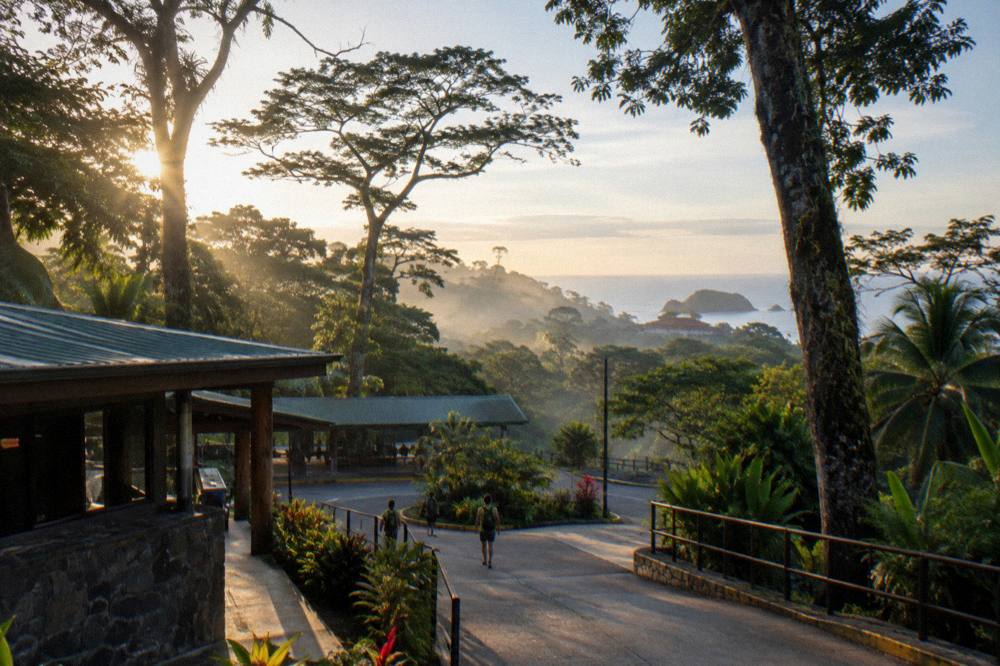
The season shapes the walk too. The dry season, roughly December to April, brings firmer trails, more visitors and hotter middays. The green season, May to November, brings afternoon rain, lusher forest and thinner crowds; Quepos records its heaviest rainfall in September and October, on the order of 500 mm each month in the long-run climate table. The national weather service's outlook for late 2026 points to the Central Pacific dry season starting between mid and late November, which is useful if you are choosing between a December trip and an October one. Rain in the green season usually arrives in afternoon pulses, another argument for the early start.
For sunset planning, note that the park closes long before the sun goes down: sunset runs from about 5:10 pm in November to about 6:00 pm in July, and the evening light belongs to the beaches and viewpoints outside the gate, not to the trails. The Manuel Antonio sunset cruise guide covers the boat-side alternative, where the coastline you just walked past is seen from the water.
How Do You Plan A Trail Day Around The Park Rules?
Build the day backwards from three fixed points: tickets bought online in advance with ID matching, arrival at or near 7:00 am on a day that is not Tuesday, and exit before the 3:00 pm closing. Slot the forest walk first while animals are active, beaches second, and keep every item on the banned list, food, drink, umbrellas, pets, out of your bag. The drinking fountains on Perezoso and the beach trails make water planning easier.
The order matters because the park's two halves reward different hours. The forest trails give their best in the first three hours after opening; the beaches are at their best once the walking is done and the midday heat argues for a swim. A guided morning listing handles this sequencing for you: the 4-hour nature-specialist tour, the site's most reviewed listing at 4.8 from 4,590 reviews, from $49 per person, with snacks and spotting scope included and the park ticket excluded so you buy it yourself online the day before.
Two logistics details are worth their own planning minute. First, there is no vehicle parking in the park, and the single road from Quepos to Manuel Antonio gets very busy in high season, so the pickup services listed on several tours are not a luxury in January. Second, the guide office hours (7:00 am to 2:00 pm for tours) mean an official guided experience inside the park is effectively a morning product; the listings that depart the park entrance at a set time keep the same rhythm.
Beyond the gate, the trail day can stretch into a fuller one. The Manuel Antonio day tours overview lines up the mangrove, rafting and catamaran options that start where the park ends, and for the question of how many days the whole area deserves, how many days in Manuel Antonio is enough does the arithmetic. The site behind this guide, Manuel Antonio Costa Rica Tours, keeps all 35 tours in one place for exactly that kind of day-stacking.
The park's own English page (sinac.go.cr) is the final word on rules, hours and closures, and the weather outlook comes from the national meteorological institute (imn.ac.cr). Check both before you lock a date.
Common Questions About Manuel Antonio Park Trails
What trails are in Manuel Antonio National Park?
The official park page lists the Perezoso vehicle trail, the connectors to Playa Manuel Antonio and Playa Espadilla Sur, the Gemelas and Puerto Escondido path, the Punta Catedral viewpoints (trail temporarily closed), Punta Serrucho, La Trampa, a seasonal waterfall, about 18 hectares of mangrove and a 14 hectare lagoon.
Is the Punta Catedral trail open?
No. The official SINAC page states the trail is temporarily closed, with no reopening date announced. The Puerto Escondido and Punta Serrucho viewpoints remain listed park sights.
How long does it take to walk through Manuel Antonio National Park?
Most visitors of ordinary fitness cover the trail network and a beach stop in a half day. Guided listings run from 2 hours to 4 hours, and the park is open 7:00 am to 3:00 pm, which sets the outer limit on any visit.
Do you need a guide for the Manuel Antonio trails?
No, the trails are easy to follow alone. But a certified naturalist with a spotting scope finds animals that untrained eyes walk past, and several listings include the scope plus photos. The choice is between navigation, which you do not need help with, and detection, which is the guide's real job.
Can you bring food and water into Manuel Antonio National Park?
No food or beverages of any kind may be carried in beyond the designated eating area, which serves from 7:30 am to 3:30 pm. Drinking-water fountains are located on the Perezoso trail and the Manuel Antonio and Espadilla Sur beach trails.
Which beaches are inside Manuel Antonio National Park?
Three: Playa Manuel Antonio, with snorkeling at its sides; Playa Espadilla Sur, wider and less crowded; and Playa Gemelas, split in two by a rock formation. Umbrellas, balls, tents and hammocks are not allowed on any of them.